
Licensed in all 50 States · 20+ Years Manufacturing Expertise · Certified Specialists
Can You Explain D&O Insurance Side A, Side B, and Side C Coverage?
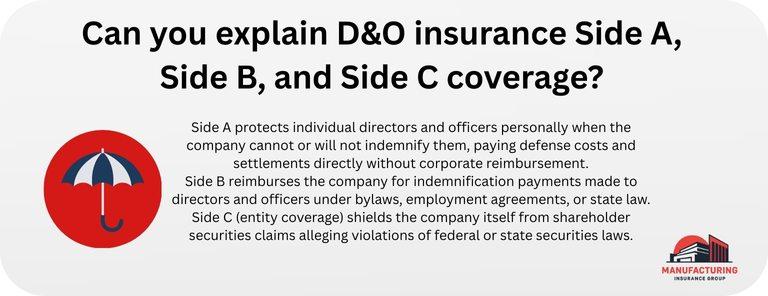
D&O insurance Side A coverage protects individual directors and officers personally when the manufacturing company cannot or will not indemnify them for defense costs and settlements, providing direct payment to insured individuals without requiring corporate reimbursement.
Side B coverage reimburses the manufacturing corporation for indemnification payments made to directors and officers under corporate bylaws, employment agreements, or state law permitting or requiring indemnification.
Side C coverage, also called entity coverage, protects the manufacturing company itself as a defendant in securities claims brought by shareholders alleging violations of federal securities laws or state securities regulations.
When manufacturers enter Chapter 7 liquidation or Chapter 11 reorganization, corporate indemnification obligations to directors and officers become unsecured claims against the bankruptcy estate, effectively eliminating practical ability to indemnify executives for defense costs in ongoing litigation.
Side A coverage responds directly to pay individual directors’ defense costs without requiring the bankrupt manufacturer to advance funds first, protecting personal assets including homes, investments, and retirement accounts from judgment creditors. Bankruptcy trustees or creditors’ committees may challenge indemnification as preferential transfers or fraudulent conveyances, making Side A the only reliable protection for manufacturing executives during corporate financial distress.
Side B coverage functions when the manufacturing company remains solvent and corporate indemnification obligations to executives are enforceable. State corporation statutes typically permit or require indemnification for directors and officers who acted in good faith and within scope of their authority, creating reimbursement obligations that Side B coverage satisfies.
Manufacturing companies benefit from Side B because it prevents defense costs and settlements from depleting working capital or affecting debt covenant compliance. The coverage responds after the manufacturer advances indemnification payments to executives, effectively converting corporate self-insurance for management liability into insured risk transferred to the D&O carrier.
Side C coverage applies exclusively to manufacturing companies facing securities litigation, whether organized as publicly traded corporations or private companies making securities offerings to investors.
The Securities and Exchange Commission securities law violations, including Section 10(b) claims under the Securities Exchange Act of 1934 alleging fraudulent statements or omissions in connection with securities purchases or sales, trigger Side C coverage.
Private manufacturing companies issuing stock to employees or seeking private equity investment face securities claims from investors alleging misrepresentations in offering documents or financial statements.
Side C coverage typically applies only to securities claims rather than all corporate litigation, meaning breach of contract claims against the manufacturing entity itself do not invoke entity coverage even though they name the company as defendant.
Manufacturing companies should structure D&O policies with adequate limits across all three coverage types.
Side A limits often equal total policy limits, providing $5 million to $25 million protection depending on company size.
Side B limits may be lower than Side A because corporate insolvency eliminating indemnification represents more severe scenario than solvent company reimbursement.
Side C limits should reflect potential securities litigation exposure, with public manufacturers requiring $25 million to $100 million entity coverage while private manufacturers may maintain lower limits between $5 million and $15 million.
To speak with an insurance expert, call (234) 231-9943 today.
Related Questions
More on Directors and Officers Insurance
Getting a Quote for Directors and Officers Insurance
Ready to protect your operations? Get expert guidance and a custom quote today.